Photo · Video · Drone · Cloud
They can't call it
pre-existing
if you have proof
We document your home before anything happens to it. Professional timestamped photos, video, and drone footage, stored in the cloud. When a storm hits, you have a dated record of exactly what your property looked like beforehand.
Serving homeowners from West Palm Beach to the Florida Keys.
Without Pre Claim Visuals
- Peril
- Windstorm
- Date of loss
- September 2026
- Prior condition
- No record on file
Evidence of prior condition
Finding. Damage attributed to pre-existing wear. Prior condition could not be verified.
With Pre Claim Visuals
- Peril
- Windstorm
- Date of loss
- September 2026
- Prior condition
- Documented 03 / 2026
Evidence of prior condition
Finding. Prior condition verified against dated pre-loss documentation of the roof and elevations.
Don't let the insurance company decide what your roof looked like. Have Pre Claim Visuals document it first.
Illustrative scenario, not a client outcome. Documentation establishes your property's prior condition; it does not guarantee any claim decision or amount. Pre Claim Visuals is not a public adjuster and does not file, negotiate, or advise on claims.
Helene claims closed with no payment
of Ian homeowners claims paid nothing
of Milton claims closed unpaid
of closed Idalia claims paid nothing
Florida Office of Insurance Regulation. Every figure sourced below.
The objection
This is the sentence that decides whether a roof is a covered loss or your problem. It costs the insurer nothing to say.
A dated record is the only thing that answers it.
“That damage was already there.”
It is the most effective sentence in the insurance business, and it works for one reason: after the storm, nobody can prove otherwise. Photos from your phone are undated and incomplete. Your memory isn't evidence. The roof nobody has looked at in six years becomes a matter of opinion, and it won't be your opinion that decides it.
“That roof was already worn.”
Dated aerial imagery of the roof surface, taken before the storm.
“Those cracks are pre-existing.”
Close-range photos of every elevation, timestamped and stored.
“We need proof of prior condition.”
A complete, organized record you can hand over the same day.
The record
This isn't a hypothetical. It's the state's own data.
Florida publishes what happens to hurricane claims. These figures come from the state regulator and from national investigative reporting. Every one of them links to its source so you can read it yourself.
vs 29,315 paid
More Helene claims closed with no payment than with one.
Of 67,266 closed homeowners claims from Hurricane Helene, 37,951 closed without a payment. Only 29,315 were paid.
of 458,743 claims
Nearly one in three Ian homeowners claims paid nothing.
Hurricane Ian produced 458,743 homeowners claims in Florida. 29.4 percent of them were closed without any payment at all.
of Milton claims
The pattern did not stop with Ian.
Hurricane Milton produced 385,146 claims. 134,177 of them closed without payment, a higher share than Ian.
of closed Idalia claims
Smaller storm, same outcome.
Hurricane Idalia was a fraction of the size, and 7,383 of 18,926 closed claims still ended with no payment.
in regulator fines
The state fined eight insurers over hurricane claims.
Florida regulators penalised eight companies for misconduct handling hurricane claims, including failing to pay or deny claims within 90 days. One showed error rates above 80 percent.
payout reductions
Payouts cut far below the field adjuster's estimate.
A Washington Post investigation reviewed claims in original and altered form and documented Ian payouts reduced by 45 to 97 percent, with roof damage reattributed to prior wear and tear.
I have asked my office to profusely inspect all closed claims without payment data.
Florida Office of Insurance Regulation, April 2025
Here is the part most people get wrong. When an insurer argues damage was already there, it builds that case with its own evidence: prior inspections, claim history, and increasingly its own aerial imagery of your roof. Documentation does not change the legal burden. It changes whether you have anything to answer with.
The process
Four steps, once a year, and it's handled.
01 — 04
We come to your home
A scheduled visit, usually under two hours. You don't need to be there for the whole thing, because we work around you.
We document everything
Every elevation, every room, the roof from the air. Photos, video, and drone footage, captured to a consistent standard so nothing is missing later.
It's stored and dated
Your full record goes to secure cloud storage with timestamps intact. It sits there doing nothing, until the day it's the most valuable thing you own.
We come back every year
Annual updates keep the record current, so the gap between your last documentation and any damage stays as small as possible.
Back to step one
What we capture
A complete record, not a phone album.
One visit covers the whole property to a consistent standard, so nothing turns out to be missing on the day it matters.
The one that decides claims
Drone aerials
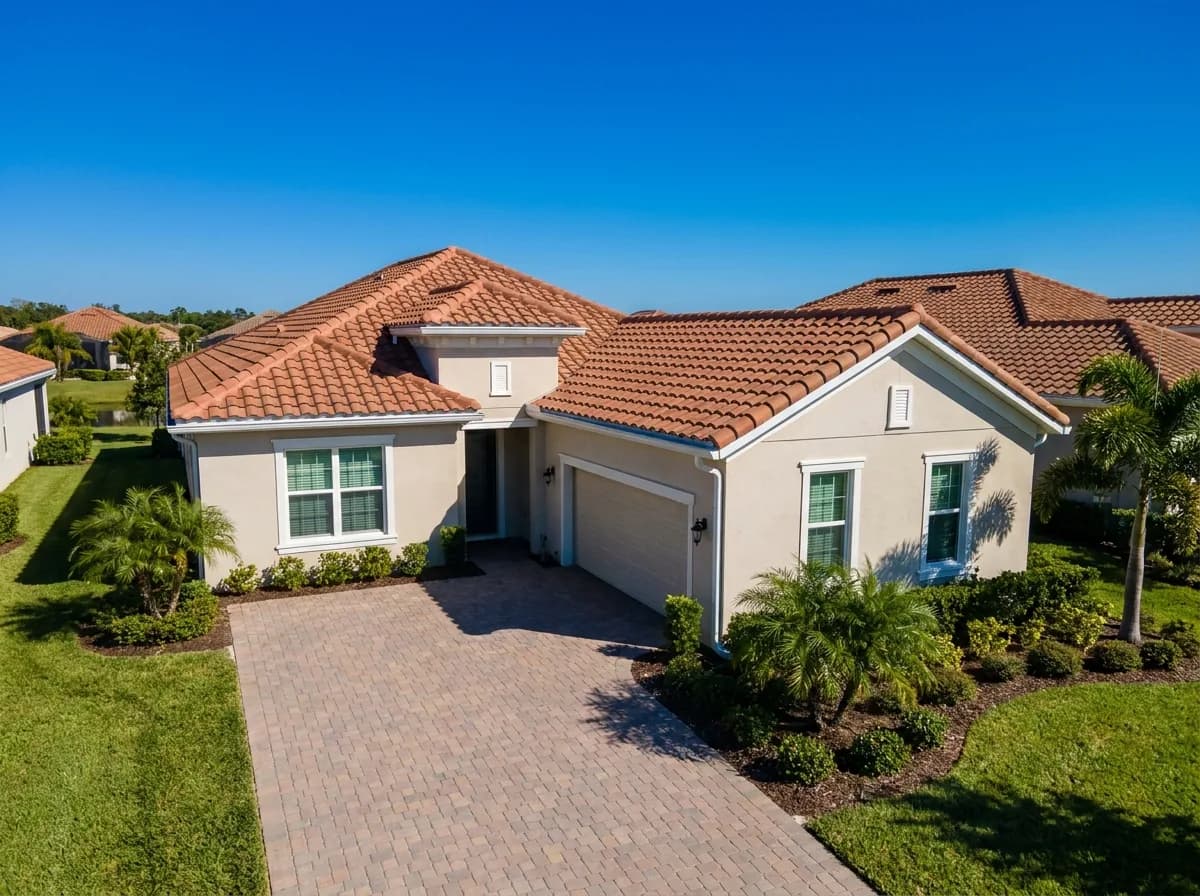
The roof is where most storm claims are fought and the hardest surface to prove. We photograph it from above, before anything happens to it.
Insurers increasingly pull their own aerial imagery of your roof. This is the same evidence, taken first, and dated.
Professional photography
Every elevation, every room, and the details that matter: roof edges, soffits, windows, flooring, finishes.
Walkthrough video
Continuous footage that shows context a still photo can't. How rooms connect, and the true condition of a whole space.
Secure cloud storage
Your record is stored off-site with timestamps intact. Hurricanes destroy filing cabinets and hard drives. They don't destroy this.
What you get
One visit a year. A record that holds up when it matters.
No packages to compare and nothing to cancel. One visit, one record, kept current.
Every visit includes
- Full interior and exterior photography
- Walkthrough video of the property
- Drone aerials of the roof and grounds
- Timestamped and organized
- Secure cloud storage of your full record
- Copies available whenever you need them
Every property is different
Size, roof type, and how much there is to cover all change what a visit involves. Book a consultation and we'll walk you through exactly what documenting your home looks like, and what it costs, before you commit to anything.
Questions
Straight answers.
Not seeing yours? Call and ask. You will get a straight answer about your property, not a sales script.
786-502-1441Do I have to be home for the visit?
For the interior portion, yes. Someone needs to let us in. The exterior and drone work doesn't require you to be there, and we'll work around your schedule.
How long does it take?
Most single-family homes take under two hours. Larger properties take longer, and we'll tell you upfront when we schedule.
Who owns the photos?
You do. It's your property and your record. We store it and give you copies whenever you ask.
Do you file my claim for me?
No. Filing, negotiating, and advising on insurance claims is licensed work in Florida, and we don't do it. We create the evidence and hand it to you. What you do with it, and who helps you do it, is your call.
Why does the yearly visit matter?
Because proof ages. A record from five years ago invites an argument about everything that happened since. An annual update keeps the gap between your documentation and any damage as small as possible.
Get started
Book your consultation.
Tell us where the property is and we'll reach out to walk you through what documenting your home involves, answer your questions, and schedule a visit when you're ready.
- We reach out to you
- We answer your questions
- We schedule when you're ready
Prefer to talk?
786-502-1441